Muay Thai Is the Art of Bare Hand Man Killing
Muay Thai (Thai: มวยไทย, RTGS: muai thai , pronounced [mūa̯j tʰāj] (  listen )), sometimes referred to equally Thai battle, is a martial art and combat sport that uses stand up-upwards striking along with various clinching techniques.[1] [2] [3] [four] [5] This field of study is known every bit the "art of viii limbs," as information technology is characterised by the combined use of fists, elbows, knees, and shins.[6] Muay Thai became widespread internationally in the late 20th to 21st century, when Westernised practitioners from Thailand began competing in kickboxing and mixed-rules matches as well as matches nether Muay Thai rules around the earth. The professional league is governed by The Professional person Boxing Association of Thailand (P.A.T), sanctioned by The Sports Authority of Thailand (Southward.A.T.).
Muay Thai is related to other martial fine art styles such as Musti-yuddha, Muay Chaiya, Muay boran, Muay Lao, Lethwei, Pradal Serey, and Tomoi.[7] [8] Muay Thai developed from the traditional Muay Boran.[9] [10] A practitioner of Muay Thai is known as a nak muay. Western practitioners in Thailand are sometimes called nak muay farang, significant "foreign boxer."[11]
History [edit]
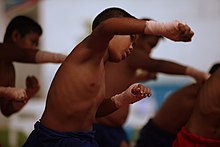
Local school children in Thailand demonstrate muay Thai
The history of Muay Thai can be traced at least to the 16th century as a peace-time martial art practised past the soldiers of Rex Naresuan.[12] An exhibition of Muay Thai was observed and reported by Simon de la Loubère, a French diplomat who was sent by King Louis 14 to the Kingdom of Siam in 1687, in his famous work and the Ayutthaya Kingdom Burmese–Siamese State of war (1765–1767)[thirteen] Muay boran, and therefore Muay Thai, was originally called past more generic names such equally toi muay or simply muay. Likewise as being a practical fighting technique for use in actual warfare, muay became a sport in which the opponents fought in front of spectators who went to watch for entertainment. These muay contests gradually became an integral part of local festivals and celebrations, especially those held at temples. Somewhen, the previously bare-fisted fighters started wearing lengths of hemp rope around their easily and forearms. This type of match was called muay khat chueak (มวยคาดเชือก).
13 century

The rising of Male monarch Chulalongkorn (Rama Five) to the throne in 1868 ushered in a gold historic period not merely for muay but for the whole state of Thailand. Muay progressed greatly during the reign of Rama Five as a straight event of the rex'due south personal interest in the sport. The land was at peace and muay functioned equally a ways of physical exercise, cocky-defense, attacking, recreation, and personal advocacy.[xiv]
The modern era [edit]
1909-1910: Male monarch Chulalongkorn formalized muay boran ("aboriginal battle") past awarding (in 1910) three muen to victors at the funeral fights for his son (in 1909). The region style: Lopburi, Korat, and Chaiya.[14]
1913: British boxing was introduced into the curriculum of the Suan Kulap College. The first descriptive use of the term "muay Thai."
1919: British boxing and muay taught every bit ane sport in the curriculum of the Suan Kulap College. Judo was also offered.
1921: Get-go permanent ring in Siam at Suan Kulap College. Used for both muay and British boxing.
1923: Suan Sanuk Stadium. First international style three-rope ring with scarlet and blue padded corners, most Lumpinee Park. Muay and British boxing.[15]
King Rama VII (r. 1925–1935) pushed for codified rules for muay, and they were put into place. Thailand'southward first boxing ring was congenital in 1921 at Suan Kulap. Referees were introduced and rounds were now timed past kick. Fighters at the Lumpinee Battle Stadium began wearing modern gloves, besides as difficult groin protectors, during training and in battle matches against foreigners. Traditional rope-binding (khat chueak) made the hands a hardened, dangerous striking tool. The use of knots in the rope over the knuckles made the strikes more annoying and dissentious for the opponent while protecting the hands of the fighter.[16] This rope-bounden was still used in fights between Thais only after the occurrence of a death in the ring, it was decided that fighters should vesture gloves and cotton coverlets over the feet and ankles. It was besides around this time that the term "muay Thai" became commonly used, while the older form of the style came to be known as "muay boran," which is now performed primarily equally an exhibition art form.

A muay boran demonstration, Lumpinee Boxing Stadium, Bangkok
Muay Thai was at the top of its popularity in the 1980s and 1990s. Top fighters commanded purses of up to 200,000 baht and the stadia where gambling was legal drew big gates and big advertising revenues. Every bit of 2016[update], a payout to a superstar fighter was about 100,000 baht per fight,[17] but can range as high as 540,000 baht for a bout.[xviii]
In 1993, the International Federation of Muaythai Apprentice, or IFMA was inaugurated. It became the governing body of apprentice muay Thai consisting of 128 fellow member countries worldwide and is recognised past the Olympic Council of Asia.
In 1995, the World Muaythai Quango, the oldest and largest professional sanctioning organisations of muay Thai, was established by the Thai authorities and sanctioned past the Sports Authority of Thailand.
In 1995, the Earth Muay Thai Federation was founded via the merger of two existing organisations, and established in Bangkok condign the federation governing international muay Thai. As of Baronial 2012, it had over 70 member countries. Its president is elected at the World Muay Thai Congress.
In 2006, muay Thai was included in SportAccord with IFMA. One of the requirements of SportAccord was that no sport can have a name of a state in its proper name. As a result, an subpoena was made in the IFMA constitution to change the name of the sport from "muay Thai" to "Muaythai"—written equally ane word in accordance with Olympic requirements.

In 2014 muay Thai was included in the International Earth Games Association (IWGA) and will be represented in the official programme of The World Games 2017 in Wrocław, Poland.
In January 2015, muay Thai was granted the patronage of the International Academy Sports Federation (FISU) and from xvi to 23 March 2015 the first University Globe Muaythai Cup was held in Bangkok.
As of 2020[update] in that location are more than 3,800 Thai boxing gyms overseas.[19]
Today, the Isan region in the northeast famously produces a lot of muay Thai boxers.[xx] Many of the boxers from Srisaket, Buriram and Surin are of ethnic Kuy(Suai), Lao, and Khmer descent.[21] Nearly of the people in the northeast area of the Khorat Plateau share traditions of faith, culture and linguistic with the Lao people that live on the other side of the Mekong River. The Lao-speaking people of this surface area call themselves, "Khon Isan" and makeup the majority of the population. The Kuy(Suai) and Khmer who live in the southern part of the northeast region take traditions and speak languages more than similar to those in Cambodia than with the Lao or Thai.[22]
Rules [edit]
According to IFMA rules and regulations, Muaythai is a martial art of using every office of your body limbs therefore making every strike including punch, kick, human knee, and elbow are allowed.
Mostly, for a strike to count towards the point score, information technology has to striking without being blocked or guarded against by the opponent. Strikes also do non score if they hit the opponent'southward glove, forearm, foot, or shin. Strikes to the groin are confronting the rules and if plant to exist intentional are counted as fouls.[23]
If both Muaythai fighters accept the same score at the end of the round, the winner is determined by which fighter has a more powerful strike.
Olympics [edit]
Timeline of International Federation of Muaythai Associations (IFMA) from founding to International Olympic Commission (IOC) recognition:[24]
- 1992 – Νational Federation of Muaythai Associations founded.
- 1995 – Ιnternational Amateur Muay Thai Federation (IAMTF) founded.
- 2012 – Official asking for International Olympic Commission (IOC) recognition launched.
- 2016 – First endorsement received.
- 2017 – Muaythai is included in the World Games.
- 2021 – On June ten, the IOC Board of Directors agreed on the full endorsement of IFMA at the 138th IOC Full general Associates in Tokyo.
- 2021 – On July 20, the IOC General Associates granted full recognition to the International Federation of Muaythai Associations (IFMA) and Muaythai.
Traditional wear [edit]

The mongkhon, or mongkol, ("headband") and pra jiad ("armbands") are ofttimes worn into the ring before the match begins. They originated when Siam was in a constant state of war. Young men would tear off pieces of a loved i'south clothing (often a mother's sarong) and wear it in boxing for skillful luck too equally to ward off harmful spirits. In mod times the mongkol (lit. "holy spirit," "luck," "protection") is worn every bit a tribute to the fighter's gym. The mongkol is traditionally presented by a trainer to the fighter when he judges that the fighter is prepare to represent the gym in the ring. Often, later the fighter has finished the wai kru, the trainer will accept the mongkol off his head and place it in his corner of the ring for luck. They were as well used for protection. Whether the fighter is a Buddhist or non, it is common for them to bring the mongkol to a Buddhist monk who blesses it for skillful luck prior to stepping into the ring.
Techniques [edit]
Formal muay Thai techniques are divided into two groups: mae mai (แม่ไม้), or "major techniques," and luk mai (ลูกไม้), or "minor techniques." Muay Thai is frequently a fighting art of attrition, where opponents substitution blows with one another.[25] This is certainly the case with traditional stylists in Thailand, but is a less popular form of fighting in the gimmicky world fighting circuit where the Thai style of exchanging blow for blow is no longer favorable. Virtually all techniques in muay Thai utilise the entire torso movement, rotating the hip with each kick, punch, elbow, and cake.
Punching (Chok) [edit]

| English | Thai | Romanization | IPA |
|---|---|---|---|
| Jab | หมัดหน้า/หมัดแย็บ | Mat na/Mat yaep | [màt nâ] |
| Cross/Straight | หมัดตรง | Mat trong | [màt troŋ] |
| Hook/Swing | หมัดเหวี่ยงสั้น | Mat tawad/mat wiang san | [màt wìəŋ sân] |
| Overhand/Haymaker | หมัดเหวี่ยงยาว | Mat khork/mat wiang yao | [màt wìəŋ jaːw] |
| Backfist/Spinning Backfist | หมัดเหวี่ยงกลับ | Mat wiang klap/Mat clap lang/Kwang jag narai | [màt wìəŋ klàp] |
| Uppercut | หมัดเสย/หมัดสอยดาว | Mat soei/Mat ngat | [màt sɤ̌j], [màt sɔ̌j daːw] |
| Superman punch/Cobra punch | กระโดดชก | Kradot chok | [kradòːt tɕʰók] |
The punch techniques in muay Thai were originally quite limited, existence crosses and a long (or lazy) circular strike fabricated with a direct (but not locked) arm and landing with the heel of the palm. Cantankerous-fertilisation with Western boxing and Western martial arts mean the full range of western boxing punches are at present used: pb jab, straight/cantankerous, hook, uppercut, shovel and corkscrew punches, and overhands, besides every bit hammer fists and back fists.
As a tactic, body punching is used less in muay Thai than most other striking combat sports to avert exposing the attacker'due south head to counter strikes from knees or elbows. To utilize the range of targeting points, in keeping with the centre line theory, the fighter can utilise either the Western or Thai stance which allows for either long range or brusk range attacks to be undertaken effectively without compromising baby-sit.
Elbow (Sok) [edit]

The elbow can be used in several ways every bit a hitting weapon: horizontal, diagonal-upwards, diagonal-downwards, uppercut, downwards, backward-spinning, and flight. From the side, it can be used as either a finishing move or as a way to cutting the opponent's eyebrow then that claret might cake his vision. The diagonal elbows are faster than the other forms but are less powerful. The elbow strike is considered the near dangerous form of set on in the sport.
| English | Thai | Romanization | IPA |
|---|---|---|---|
| Elbow Slash | ศอกตี (ศอกสับ) | Sok ti | [sɔ̀ːk tiː] |
| Horizontal Elbow | ศอกตัด | Sok tat | [sɔ̀ːk tàt] |
| Uppercut Elbow | ศอกงัด | Sok ngat | [sɔ̀ːk ŋát] |
| Forward Elbow Thrust | ศอกพุ่ง | Sok phung | [sɔ̀ːk pʰûŋ] |
| Reverse Horizontal Elbow | ศอกเหวี่ยงกลับ (ศอกกระทุ้ง) | Sok wiang klap | [sɔ̀ːk wìəŋ klàp] |
| Spinning Elbow | ศอกกลับ | Sok klap | [sɔ̀ːk klàp] |
| Double Elbow Chop | ศอกกลับคู่ | Sok klap khu | [sɔ̀ːk klàp kʰûː] |
| Mid-Air Elbow Strike/Jump elbow chop | กระโดดศอก | Kradot sok | [kradòːt sɔ̀ːk] |

Horizontal Elbow (Sok tat)
There is a singled-out deviation between a single elbow and a follow-upwards elbow. The unmarried elbow is a move independent from whatever other, whereas a follow-up elbow is the second strike from the aforementioned arm, existence a claw or straight punch first with an elbow follow-upward. Such elbows, and most other elbow strikes, are used when the distance between fighters becomes too modest and there is also little space to throw a claw at the opponent'due south head.
Elbows tin can be used to dandy effect equally blocks or defences against, for case, spring knees, side torso knees, torso kicks, or punches. When well connected, an elbow strike can cause serious damage to the opponent, including cuts or even a knockout.
Kicking (Te) [edit]
| English | Thai | Romanization | IPA |
|---|---|---|---|
| Direct Boot | เตะตรง | Te trong | [tèʔ troŋ] |
| Roundhouse Kick | เตะตัด | Te tat | [tèʔ tàt] |
| Diagonal Kick | เตะเฉียง | Te chiang | [tèʔ tɕʰǐəŋ] |
| One-half-Shin, Half-Knee Kick | เตะครึ่งแข้งครึ่งเข่า | Te khrueng khaeng khrueng khao | [tèʔ kʰrɯ̂ŋ kʰɛ̂ŋ kʰrɯ̂ŋ kʰàw] |
| Reverse Roundhouse Kicking | เตะกลับหลัง | Te klap lang/Jorakhe faad hang | [tèʔ klàp lǎŋ] |
| Down Roundhouse Kick | เตะกด | Te kot | [tèʔ kòt] |
| Axe Heel Kicking | เตะเข่า | Te khao | [tèʔ kʰàw] |
| Leap Kick | กระโดดเตะ | Kradot te | [kradòːt tèʔ] |
| Step-Up Kicking | เขยิบเตะ | Khayoep te/yiep te | [kʰa.jɤ̀p tèʔ] |

The two most common kicks[26] in muay Thai are known every bit the thip (literally "pes jab") and the te chiang (kick upwards in the shape of a triangle cutting under the arm and ribs), or roundhouse boot. The Thai roundhouse boot uses a rotational movement of the unabridged body and has been widely adopted by practitioners of other combat sports. It is done from a circular stance with the back leg merely a lilliputian ways back (roughly shoulder width apart) in comparison to instinctive upper body fighting (battle) where the legs must create a wider base. The roundhouse kicking draws its power near entirely from the rotational move of the hips, counter-rotation of the shoulders and arms are too oft used to add together torque to the lower body and increase the ability of the kicking as well.[27]
If a roundhouse kick is attempted past the opponent, the Thai boxer will normally check the kick, that is, he will cake the kick with the exterior of his lower leg. Thai boxers are trained to always connect with the shin. The foot contains many fine bones and is much weaker. A fighter may end up hurting himself if he tries to strike with his foot or instep. Shins are trained past repeatedly hitting firm objects, such as pads or heavy bags.
Human knee (Ti Khao)[28] [edit]

| English | Thai | Romanization | IPA |
|---|---|---|---|
| Directly Knee joint Strike | เข่าตรง | Khao trong | [kʰàw troŋ] |
| Diagonal Human knee Strike | เข่าเฉียง | Khao chiang | [kʰàw tɕʰǐəŋ] |
| Curving Articulatio genus Strike | เข่าโค้ง | Khao khong | [kʰàw kʰóːŋ] |
| Horizontal Articulatio genus Strike | เข่าตัด | Khao tat | [kʰàw tàt] |
| Knee Slap | เข่าตบ | Khao ti/khao top | [kʰàw tòp] |
| Knee Bomb | เข่ายาว | Khao yao | [kʰàw jaːw] |
| Flying Knee | เข่าลอย | Khao loi | [kʰàw lɔːj] |
| Step-Upwards Knee Strike | เข่าเหยียบ | Khao yiap | [kʰàw jìəp] |
- Khao dot [kʰàw dòːt] (Jumping genu strike) – the boxer jumps upwards on i leg and strikes with that leg's knee.
- Khao loi (Flying knee strike) – the boxer takes a step(s), jumps forward and off i leg and strikes with that leg's human knee.
- Khao thon [kʰàw tʰoːn] (Straight knee strike) – the boxer simply thrusts it forwards but not up, unless he is holding an opponent'due south head down in a assure and intend to knee upwardly into the face. According to one written source, this technique is somewhat more contempo than khao dot or khao loi.[ citation needed ] Supposedly, when the Thai boxers fought with rope-bound hands rather than the modern battle gloves, this particular technique was subject to potentially brutal cutting, slicing and sawing by an alert opponent who would block it or deflect it with the sharp "rope-glove" edges which are sometimes dipped in water to make the rope much stronger. This explanation as well holds truthful for some of the following knee strikes below as well.
Foot-thrust (Teep) [edit]

One fighter executes a Muay Thai Human foot-thrust (Thip) kicking against her opponent in a women's Muay Thai match.
The foot-thrust, or literally, "foot jab," is one of the techniques in muay Thai. Information technology is mainly used as a defensive technique to control distance or block attacks. Foot-thrusts should be thrown rapidly but with enough force to knock an opponent off remainder.
| English | Thai | Romanization | IPA |
|---|---|---|---|
| Straight Foot-Thrust | ถีบตรง | Thip trong | [tʰìːp troŋ] |
| Sideways Pes-Thrust | ถีบข้าง | Thip khang | [tʰìːp kʰâːŋ] |
| Reverse Foot-Thrust | ถีบกลับหลัง | Thip klap lang | [tʰìːp klàp lǎŋ] |
| Slapping Foot-Thrust | ถีบตบ | Thip height | [tʰìːp tòp] |
| Jumping Pes-Thrust | กระโดดถีบ | Kradot thip | [kradòːt tʰìːp] |
Assure and neck wrestling (Chap kho) [edit]

Ram Muay, rituals earlier the match
In Western battle, the two fighters are separated when they clinch; in muay Thai, still, they are not. It is oft in the clinch where knee and elbow techniques are used. To strike and bind the opponent for both offensive and defensive purposes, small amounts of stand-upward grappling are used in the clinch. The front clinch should be performed with the palm of 1 manus on the dorsum of the other. In that location are three reasons why the fingers must not be intertwined. 1) In the band fighters are wearing boxing gloves and cannot intertwine their fingers. ii) The Thai front clinch involves pressing the caput of the opponent downwards, which is easier if the hands are locked backside the back of the head instead of behind the neck. Furthermore, the artillery should be putting every bit much pressure on the neck as possible. 3) A fighter may incur an injury to one or more than fingers if they are intertwined, and it becomes more than difficult to release the grip in order to quickly elbow the opponent's caput.
A correct clinch also involves the fighter's forearms pressing against the opponent'due south collar os while the easily are around the opponent's head rather than the opponent's cervix. The general way to become out of a clinch is to push the opponent's caput astern or elbow them, as the assure requires both participants to be very close to one another. Additionally, the not-dominant clincher can try to "swim" their arm underneath and within the opponent's clinch, establishing the previously not-ascendant clincher as the dominant clincher.
Muay Thai has several other variants of the assure or chap kho [tɕàp kʰɔː], including:
- arm assure: One or both easily controls the inside of the defender's arm(southward) and where the second manus if free is in the front end clinch position. This clinch is used to briefly command the opponent before applying a knee joint strike or throw
- side assure: One arm passes around the front of the defender with the attacker'south shoulder pressed into the defender's arm pit and the other arm passing circular the back which allows the attacker to apply knee strikes to the defender'southward back or to throw the defender readily.
- low clinch: Both controlling arms laissez passer under the defender's arms, which is by and large used by the shorter of two opponents.
- swan-neck: 1 hand around the rear of the cervix is used to briefly assure an opponent before a strike.[ commendation needed ]
Defence force against attacks [edit]

Defences in muay Thai are categorised in 6 groups:
- Blocking – defender'south difficult blocks to terminate a strike in its path so preventing it reaching its target (e.g. the shin cake described in more than detail beneath)
- Parries – defender's soft parries to change the management of a strike (due east.g. a downwards tap to a jab) so that information technology misses the target
- Avoidance – moving a body part out of the mode or range of a strike so the defender remains in range for a counter-strike. For example, the defender moves their front leg backward to avoid the attacker's depression kick, then immediately counters with a roundhouse kick. Or the defender might lay their caput back from the aggressor's high roundhouse kick then counter-attack with a side kicking.
- Evasion – moving the torso out of the way or range of a strike so the defender has to motility close again to counter-attack, e.g. defender jumping laterally or back from attacker's kicks
- Disruption – Pre-empting an attack e.m. with defender using disruptive techniques like jab, foot-thrust or low roundhouse kick, mostly called a "leg kick" (to the outside or inside of the attacker'south front leg, just above the knee) equally the aggressor attempts to shut distance
- Anticipation – Defender catching a strike (due east.chiliad., catching a roundhouse kick to the body) or countering it before it lands (due east.g., defender's low kicking to the supporting leg below as the attacker initiates a high roundhouse kick).
Defences in practice [edit]
Defensively, the concept of "wall of defence" is used, in which shoulders, arms and legs are used to hinder the assailant from successfully executing techniques. Blocking is a critical chemical element in muay Thai and compounds the level of conditioning a successful practitioner must possess. Low and mid torso roundhouse kicks are usually blocked with the upper portion of a raised shin (this block is known as a "check"). Loftier body strikes are blocked ideally with the forearms and shoulder together, or if enough time is immune for a parry, the glove (elusively), elbow, or shin volition exist used. Midsection roundhouse kicks can also be defenseless/trapped, allowing for a sweep or counter-attack to the remaining leg of the opponent. Punches are blocked with an ordinary boxing guard and techniques similar, if non identical, to bones boxing technique. A common ways of blocking a punch is using the manus on the same side as the oncoming punch. For example, if an orthodox fighter throws a jab (beingness the left hand), the defender volition brand a slight tap to redirect the punch's angle with the right paw. The deflection is always equally small and precise as possible to avoid unnecessary free energy expenditure and return the hand to the guard as quickly equally possible. Hooks are often blocked with a motion sometimes described as "combing the pilus," that is, raising the elbow forward and effectively shielding the head with the forearm, flexed biceps, and shoulder. More than advanced muay Thai blocks are usually in the form of counter-strikes, using the opponent's weight (equally they strike) to amplify the damage that the countering opponent can evangelize. This requires impeccable timing and thus can generally just exist learned by many repetitions.
Kid boxers [edit]

In Thailand, children oftentimes start practicing Muay Thai and perform in the ring from the historic period of 5.
In 2016, nine,998 children under the age of 15 were registered with Board of Boxing under the Sport Authority of Thailand, according to the Child Safety Promotion and Injury Prevention Research Centre (CSIP).[29] Four hundred twenty young boxers registered with the board annually, betwixt 2007 and 2015.[29] Some estimates put the number of child boxers nationwide at between 200,000 and 300,000, some as immature equally four years sometime.[30]
The Advanced Diagnostic Imaging Centre (AIMC) at Ramathibodi Hospital studied 300 child boxers aged under 15 with two to more five years of feel, as well as 200 children who do not box. The findings show that child boxers not only sustain brain injuries, they also have a lower IQ, almost ten points lower than average levels. Moreover, IQ levels correlate with the length of their training.[thirty] [31] Across brain impairment, the death of young fighters in the ring sometimes occurs.[32]

Adisak Plitapolkarnpim, director of CSIP,[33] was indirectly quoted (in 2016) as having said that muay Thai practitioners "younger than 15 years old are being urged to avert 'head contact' to reduce the risk of brain injuries, while children aged under 9 should be banned from the gainsay fight"; furthermore, the Boxing Human action's minimum age to compete professionally was largely existence flouted; furthermore, indirectly quoted: "Boxers aged between xiii and 15" should nevertheless be permitted to compete, but "with low-cal contact to the head and confront";[29] he said that "Spectators and a change in the boxing rules tin play a vital part in preventing child boxers from suffering brain injuries, abnormality in brain structure, Parkinson's disease and early-onset Alzheimer's after in life...Children anile between nine and 15 can take part in [Thai] battle, simply directly head contact must non be allowed." Referring to Findings [of 2014] on the Worst Forms of Child Labour as published past the U.s. Department of Labor'south Agency of International Labor Diplomacy, he said that, "We know Muay Thai paid fighters take been exploited in the past similar child labourers and the matter still remains a serious concern".[29]
At the 13th World Conference on Injury Prevention and Safe Promotion in 2018, it was revealed that upwards to three percentage of the upcoming generation volition grow upward with learning disabilities unless an subpoena is ratified that bans children nether 12 from participating in boxing matches. International pediatricians have called on lawmakers in Thailand to help.[34]
Injuries [edit]
Muay Thai is a combat sport that utilises eight different parts of the body (fists, elbows, knees, and shins); therefore, injuries are quite common in all levels of muay Thai. An injury is considered reportable if it requires the athlete to rest for more than than one mean solar day. Many injuries in the sport of muay Thai go unreported every bit the fighters may not notice the injuries at first, refuse to admit that they need treatment, have a heightened pain threshold, fright that their teacher volition perceive the injury negatively, or have confusion as to what is an injury.[35] Similar to virtually sports, injury rates tend to be higher in beginners than amateurs and professionals. Soft tissue injuries are the most mutual form of injury in muay Thai, comprising between 80 and 90% of all injuries. These injuries are acquired by repeated trauma to soft parts of the body. During matches at that place is little to no padding, leaving soft tissue vulnerable to strikes. The 2nd almost mutual injuries among beginner and apprentice muay Thai fighters are sprains and strains. It appears that these injuries can be hands avoided or reduced. Many participants of a written report admitted to inadequate warm up before the event of the injury.[35] The third well-nigh common injuries are fractures. Fractures are more commonly seen with amateur and professional fighters, because they are immune full contact, while beginners are allowed no contact. The most common sites for fractures are the nose, carpal bones, metacarpals, digits, and ribs. The distribution of injuries differs significantly for beginners, amateurs and professionals, considering as a fighter progresses through the unlike levels, the forces involved grow progressively higher, less padding and protective equipment is used, and athletes are likely to train harder, resulting in more serious injuries among experienced fighters.
Gambling [edit]

Thai boxer during a fight on Koh Samui
According to a Bangkok Post columnist, "...Thai professional boxing is all most gambling and big money. Gambling on muay Thai boxing is estimated to worth well-nigh 40 billion baht a twelvemonth....all the talk near the promotion of Thai martial arts is just baloney."[nineteen] Rob Cox, the manager of a battle camp just east of Bangkok claims that "Without the gamblers, the sport would pretty much be dead. They're killing it off, merely they're too keeping it live."[17]
The practice of fixing fights is not unknown. Boxers can earn from 60,000 to 150,000 baht for purposefully losing a fight. A fighter, after arrested, who threw a fight at Rajadamnern Stadium in Dec 2019, is only the almost contempo example.[36] An infamous declared case of match-fixing was the bout on 12 Oct 2014 in Pattaya between top Thai boxer Buakaw Banchamek and his challenger, Enriko Kehl, at the Chiliad-i Globe Max Last event.[19]
Folklore [edit]
An urban fable started existence told past Thai people in 1767 effectually the time of the fall of the ancient Siamese capital of Ayutthaya, when the invading Burmese troops rounded up thousands of Siamese citizens. They then organised a vii-twenty-four hour period, seven-night religious festival in honour of Buddha's relics. The festivities included many forms of entertainment, such equally costume plays, comedies and sword fighting matches. Co-ordinate to the sociology story, at one point, King Mangra wanted to see how Thai fighters would compare to his fighters. Nai Khanomtom was selected to fight confronting the King'due south chosen champion and the boxing ring was ready up in front of the throne. When the fight began, Nai Khanomtom charged out, using punches, kicks, elbows, and knees to pummel his opponent until he collapsed. The King supposedly asked if Nai Khanomtom would fight 9 other Burmese champions to prove himself. He agreed and fought one later on the other with no residuum periods. His terminal opponent was a great kickboxing teacher from Rakhine State whom Nai Khanomtom defeated with kicks.[37]
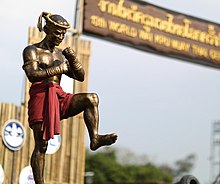
Every twelvemonth on March 17th, Thailand celebrate the Nai Khanom Tom 24-hour interval.
King Mangra was then impressed that he allegedly remarked that "[e]very part of the Siamese is blest with venom. Even with his blank easily, he can fell nine or x opponents. But his Lord was incompetent and lost the land to the enemy. If he had been whatsoever good, in that location was no way the Metropolis of Ayutthaya would e'er have fallen."[38]
To commemorate the story of Nai Khanom Tom, the Muay Thai Festival and Wai Khru Muay Thai Ceremony are staged annually every year on March 17.[39]
Conditioning [edit]
Like almost full contact fighting sports, Muay Thai has a heavy focus on body conditioning.[40] This can create a steep learning curve for newcomers to Muay Thai but allows for rapid increases in fettle and stamina provided ane avoids overtraining.[41] Training regimens include many staples of combat sport conditioning such as running, shadowboxing, rope jumping, body weight resistance exercises, medicine ball exercises, abdominal exercises, and, in some cases, weight training. Thai boxers rely heavily on kicks utilising the shin bone. As such, practitioners of muay Thai will repeatedly hit a dense heavy bag with their shins, conditioning information technology, hardening the bone through a procedure called cortical remodelling.[42] Striking a sand-filled handbag volition accept the same outcome.

A fighter punching a heavy bag at a training camp in Thailand
Training specific to a Thai fighter includes training with coaches on Thai pads, focus mitts, heavy bag, and sparring. Daily training includes many rounds (3–5 minute periods broken up past a short rest, often ane–2 minutes) of these various methods of do. Thai pad training is a cornerstone of muay Thai conditioning that involves practicing punches, kicks, knees, and elbow strikes with a trainer wearing thick pads covering the forearms and hands. These special pads (oft referred to as Thai pads) are used to blot the impact of the fighter's strikes and allow the fighter to react to the attacks of the pad holder in a alive situation. The trainer volition often also wear a abdomen pad around the abdominal surface area so that the fighter tin assail with direct kicks or knees to the body at whatsoever time during the round.
Focus mitts are specific to training a fighter's hand speed, dial combinations, timing, punching power, defence, and counter-punching and may too be used to practice elbow strikes. Heavy pocketbook training is a conditioning and power exercise that reinforces the techniques practiced on the pads. Sparring is a means to exam technique, skills, range, strategy, and timing against a partner. Sparring is oft a lite to medium contact do because competitive fighters on a full schedule are non brash to risk injury by sparring hard. Specific tactics and strategies can be trained with sparring including in close fighting, clinching and kneeing only, cutting off the ring, or using attain and altitude to keep an aggressive fighter abroad.
Due to the rigorous training regimen (some Thai boxers fight almost every other week), professional boxers in Thailand take relatively short careers in the ring. Many retire from competition to brainstorm instructing the next generation of Thai fighters. Almost professional Thai boxers come from lower economical backgrounds, and the purse (subsequently other parties get their cut) is sought equally means of support for the fighters and their families.[43] Very few higher economic strata Thais join the professional muay Thai ranks; they unremarkably either exercise not practice the sport or practice it merely as amateur boxers.[44] [45]
Famous practitioners [edit]
Popular culture [edit]
- In the 1999 version of The King and I, the Prince uses Muay Thai.
- Muay Thai is featured prominently in the Street Fighter series as a common martial art between characters. The character Sagat is referred to in-universe as "The Emperor of Muay Thai."
- The Marvel Cinematic Universe features Muay Thai used by Shang Chi, Hope van Dyne and George Batroc.
See besides [edit]
- Muay Boran
- Muay Chaiya
- Muay Lerdrit
- Wai khru ram muay
- Pra Jiad
- Mongkhon
- Muay Thai in popular culture
- Krabi–krabong
- Pencak silat
References [edit]
- ^ Newhall, Lindsey (2015-ten-26). "Preserving the Archetype Technique of Maemai Muay Thai". Fightland. Vice. Retrieved 2016-03-29 .
- ^ Colman, David (2005-01-09). "It'southward Paw-to-Mitt for a Keeper of Faces". The New York Times . Retrieved 2010-08-10 .
- ^ Fuller, Thomas (2007-09-xvi). "Sugar and Spice and a Vicious Correct: Thai Boxing Discovers Its Feminine Side". The New York Times . Retrieved 2010-08-10 .
- ^ Perry, Alex (2001-06-11). "Fighting for Their Lives". Time. Archived from the original on October 30, 2010. Retrieved 2010-12-07 .
- ^ "Muay Thai History". March 4, 2016.
- ^ Kuswandini, Dian (2009-07-22). "Get fit the Muaythai way". The Dki jakarta Post . Retrieved 2015-03-04 .
- ^ Wikipedia, Source (1 September 2013). Gainsay Sports: Boxing, Taekwondo, Judo, Fencing, Sumo, Kendo, Grappling, Kickboxing, Savate, Battle Training, Paralympic Judo, Brazilian Jiu-Jitsu, Mi. General Books. ISBN9781230563480 . Retrieved v April 2018 – via Google Books.
- ^ Wee, Lionel; Goh, Robbie B. H. (24 October 2019). Language, Infinite and Cultural Play: Theorising Affect in the Semiotic Landscape. ISBN9781108472203 . Retrieved nine July 2020.
- ^ "Awesome Muay Thai" (PDF). Tourismthailand.org.
- ^ "Muay Thai vs. Muay Boran". Feb 2, 2017.
- ^ Reynolds, Alex (2006-01-24). "Fighting every bit a 'farang' for a fist total of Baht". Telegraph. London. Retrieved 2010-08-10 .
- ^ "IN FRIENDLY THAILAND, Battle MATCHES ARE BRAWLS". Chicago Tribune.
- ^ "History". Thaiboxing.com. 2015-04-18. Archived from the original on 2015-06-30. Retrieved 2015-06-13 .
- ^ a b "AWESOME MUAY THAI".
- ^ "The Modernization of Muay Thai - A Timeline | Sylvie von Duuglas-Ittu". 8Limbs.us. 2015-01-x. Retrieved 2015-06-13 .
- ^ Patterson, Jeff. "Know Your Muay Thai: Manus Wraps". nwfighting.com. Northwest Fighting Arts. Retrieved 4 March 2014.
- ^ a b Zandstra, Tate (13 October 2016). "Blood, sweat and debt". Southeast Asia Globe . Retrieved 3 April 2020.
- ^ Krausz, Tibor (xv October 2018). "Muay Thai kid fighters put their health on the line for gamblers and hope of a better life". Due south China Morning time Post . Retrieved 3 April 2020.
- ^ a b c Prateepchaikul, Veera (30 March 2020). "Army'due south part in boxing a shady affair" (Opinion). Bangkok Post . Retrieved 30 March 2020.
- ^ Historic ABC of Thailand. (n.d.). (due north.p.): Lulu.
- ^ Vail, P. T. (1998). Modern "MUAI THAI" MYTHOLOGY. Crossroads: An Interdisciplinary Journal of Southeast Asian Studies, 12(two), 75–95. http://www.jstor.org/stable/40860679
- ^ Thailand - Settlement patterns. (due north.d.). Britannica. Retrieved April 18, 2022, from https://www.britannica.com/identify/Thailand/Settlement-patterns#ref274209
- ^ "Muaythai Rules – International Federation of Muaythai Associations". Retrieved 2022-02-19 .
- ^ "Muay Thai, IFMA fully recognized past IOC". nationthailand. 2021-07-20. Retrieved 2021-07-21 .
- ^ "Muay Thai | Muay Pro | Muay Pro Muay Thai % | Muay Thai". Muay Pro . Retrieved 2020-09-01 .
- ^ "v Primary Kicking Techniques In Muay Thai". Muay Thai Teacher. 2016-04-05. Archived from the original on Baronial 26, 2018. Retrieved 2016-12-22 .
- ^ Cimadoro, Giuseppe; Mahaffey, Ryan; Babault, Nicolas (April 2018). "Astute neuromuscular responses to brusk and long roundhouse kick striking paces in professional person Muay Thai fighters" (PDF). The Journal of Sports Medicine and Physical Fitness. 59 (2): 204–209. doi:10.23736/S0022-4707.18.08295-6. PMID 29619797. S2CID 4647910.
- ^ "Muay Thai Weapons" (PDF). Archived from the original (PDF) on 2013-12-02. Retrieved 2012-12-29 .
- ^ a b c d Jitcharoenkul, Prangthong (2016-12-26). "Expert urges 'no caput contact' amid young boxers". Bangkok Post . Retrieved 2018-x-27 .
- ^ a b "Doctors call for crackdown on child battle". Bangkok Postal service. 22 Dec 2017. Retrieved 22 December 2017.
- ^ Amsangiam, Lerpong; Panyasuppakun, Kornrawee (27 October 2018). "The high toll of Muay Thai". The Nation . Retrieved 27 Oct 2018.
- ^ "Child boxer dies after fight". Bangkok Post. xiii November 2018. Retrieved thirteen November 2018.
- ^ "Assoc. Prof. Plitapolkarnpim Adisak". ThaiScience (วิทยาศาสตร์ไทย). Archived from the original on eighteen May 2017. Retrieved 26 Jan 2017.
- ^ "The worst type of child corruption – Doctors call on ban for underage boxing". The Thaiger. 2018-11-08. Retrieved 2018-11-08 .
- ^ a b Gartland, Malik (2001). "Injury and injury rates in muay Thai kick boxing". Gale Group. 35 (5): 308–13. doi:ten.1136/bjsm.35.five.308. PMC1724381. PMID 11579062.
- ^ Cox, Rob (31 Jan 2019). "The fall of a fighter: corruption and gambling in Muay Thai". Asian MMA . Retrieved 3 Apr 2020.
- ^ "Nai Khanom Tom: Father of Muay Thai". Archived from the original on 2020-06-27. Retrieved 2020-07-09 .
- ^ Express, Bangkok Postal service Public Visitor. "A celebration of all things muay Thai" – via www.bangkokpost.com.
- ^ "Spain Pays Respect to Nai Kanom Tom". 2012-02-20. Retrieved 2013-05-11 .
- ^ Gordon, Mclean (2013-05-22). "Muay Thai, Economic Realities, and Cultural Differences". Fightland. Vice. Retrieved 2015-03-04 .
- ^ Darius, Moaz (2021-09-01). "Muay Thai Training Stories". MuaThaiInsights. MuayThai15. Retrieved 2021-09-09 .
- ^ Bakery, Donnie (2012-10-28). "Muay Thai: Beyond The Band: Superlative three Muay Thai Shin Conditioning Myths Debunked". Oldstylemuaythai.blogspot.co.uk . Retrieved 2015-03-04 .
- ^ Newhall, Lindsey (2015-01-16). "An American Sociologist Is Studying the Behavior of Muay Thai". Fightland. Vice. Retrieved 2015-03-04 .
- ^ Newhall, Lindsey (2015-02-13). "The Earth Muay Thai Angels: Marketing the Women Fighters of Thailand". Fightland. Vice. Retrieved 2015-03-04 .
- ^ Newhall, Lindsey (2014-09-04). "An American in Thailand: Muay Thai for the Rich". Fightland. Vice. Retrieved 2015-03-04 .
Further reading [edit]
- Kraitus, Panya (1992), Muay Thai The Most Distinguished Art of Fighting, Phuket: Transit Press, ISBN974-86841-ix-9
- Muay Thai The Essential Guide To The Fine art of Thai Battle. Tony Moore. New Holland. ISBN 1 84330 596 viii.
- Boykin, Chad (2002), Muay Thai Kickboxing – The Ultimate Guide to Conditioning, Preparation and Fighting, Boulder, CO: Paladin Press, ISBN1-58160-320-7
- Prayukvong, Kat (2006), Muay Thai: A Living Legacy, Bangkok, Thailand: Spry Publishing Co., Ltd, ISBN974-92937-0-3
- Hartig, Bastian (2018-12-04). Thai battle: The unsafe fight confronting poverty (Video). Deutsche Welle. Retrieved 2018-12-06 .
- Nusch, Florian (2017-12-09). Child Thai boxers: A fighting chance (Video). Deutsche Welle. Retrieved 2018-12-06 .
- Wei, Lindsey (2020) Path of the Spiritual Warrior: Life and Teachings of Muay Thai Fighter Pedro Solana. Auckland: Purple Cloud Press, ISBN 979-8651807901
loosegainglaing1952.blogspot.com
Source: https://en.wikipedia.org/wiki/Muay_Thai
0 Response to "Muay Thai Is the Art of Bare Hand Man Killing"
Post a Comment